

Virtual Reality and Augmented Reality for Legal Education and Popularization

The Cyberjustice Laboratory is exploring the use of immersive technologies, particularly virtual reality (VR) and augmented reality (AR), to facilitate legal education and popularization. The Immersive Learning project aims to develop interactive capsules that illustrate legal concepts in an accessible and engaging way for both students and those new to the field of law.
Legal education often relies on abstract texts and complex principles. However, visualization and immersive interaction can enhance comprehension and retention of legal concepts. This project addresses a pedagogical gap by offering intuitive visual aids to illustrate fundamental notions. It represents an evolution from traditional slideshows, providing a more dynamic and interactive approach to learning.
⮕ For more details on the hardware and software used, click here

The Meta Quest 3 is a standalone virtual reality headset that allows users to explore immersive worlds, play games, work, or interact in mixed reality (VR and AR) without requiring a PC or cables.

The Unity software is a powerful game engine that enables the creation of interactive experiences in 2D, 3D, VR, and AR, featuring intuitive visual tools and C# programming.
⮕ Example Capsule : Civil Liability
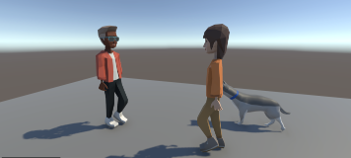
VR/AR Scene Description
- Characters : A woman (30 years old, dressed in blue and gray), a small brown dog, a man in business attire being attacked.
- Environment : Gray floor, interface displaying legal texts on a gray background with a black frame.
- Technologies : AR modeling or Unity-based scene, interactive features (zoom, movement), animation loop.
Legal Framework
Article 1457 of the Civil Code of Québec
Every person has a duty to adhere to rules of conduct and must not cause harm to others. Civil liability is based on three elements:
- A fault : A violation of a rule of prudence.
- Damage : A suffered harm (material, bodily, or moral).
- A causal link: The relationship between the fault and the harm.
The capsules also illustrate liability for property ownership (Articles 1465-1468 CCQ), where an owner may be held responsible for damages caused by an animal under their care.
Project Phases
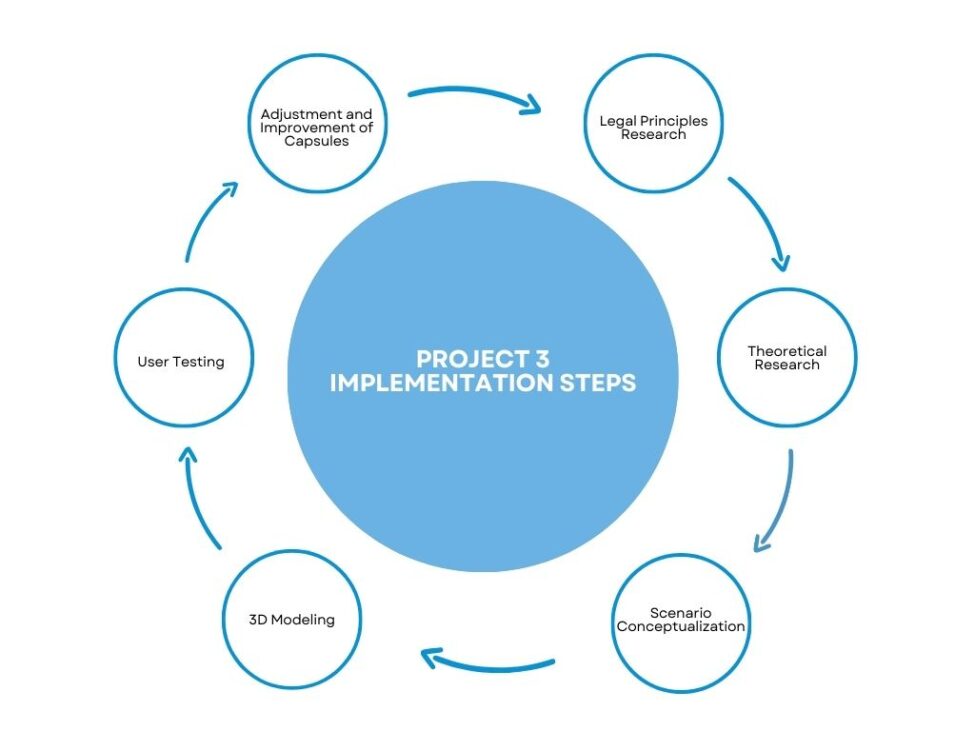
- Identify legal concepts to be represented in 3D.
- Summarize theoretical documentation on the effects of immersive technologies on legal education, exploring topics such as:
- Affordance and semiotics
- Principles of ergonomics
- Symbols of law and justice in Canada
- Technophobia and technophilia
- Disruptive technologies
- Technology Acceptance Model (TAM)
- Develop educational scenarios tailored to learners' needs.
- Model 3D legal concepts in Unity.
- Conduct user testing to assess the effectiveness and comprehension of the materials.
- Refine and improve the capsules based on user feedback.
Expected Outcomes
Medium-Term Goals
- Publish an article summarizing the findings from theoretical and practical research.
- Develop ten interactive capsules covering civil law principles and concepts, accessible for the summer school organized by the Cyberjustice Laboratory.
Long-Term Goals
- Launch an online reference database of interactive capsules covering fundamental legal concepts and principles.
This content has been updated on 06/02/2025 at 12 h 19 min.