
This summary highlights key ideas from Professor Amy J. Schmitz’s article, “Evolution of E-Commerce Online Dispute Resolution (ODR) Through the Lens of Digital Dispute System Design.”
 Amy J. Schmitz holds the John Deaver Drinko-Baker & Hostetler Endowed Chair in Law at Moritz College ofLaw, Ohio State University. She serves as co-director of the Translational Data Analytics Institute Responsible Data Science Community of Practice and is the director of the JusticeTech Capstone and Fellowship Program, while also working with the Program on Dispute Resolution, Program on Data Governance and the DividedCommunity Project. She has been a researcher at the Cyberjustice Laboratory for over 7 years, notably as part of the ACT (Autonomy through Cyberjustice Technologies) Partnership
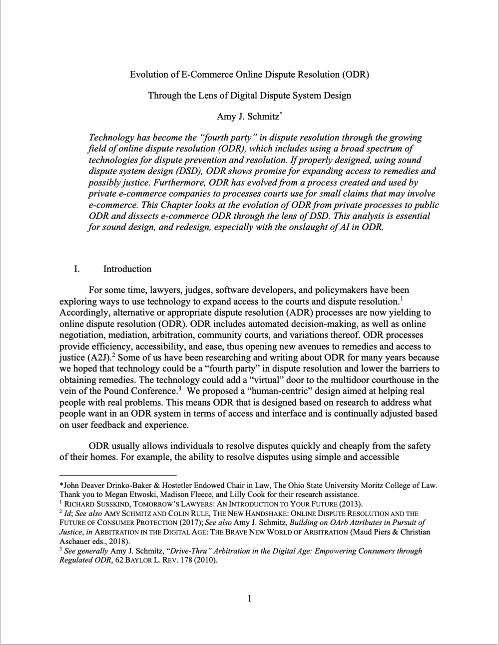
In this article, Amy J. Schmitz traces the evolution of Online Dispute Resolution (ODR), beginning with its early use on e-commerce platforms such as eBay and Amazon and following its expansion into public court systems for small-claims disputes. She explains that technology is no longer just an external tool. It has become part of the dispute resolution process itself, with the potential either to expand access to justice or, if poorly designed, to create new inequalities.
“Technology has become the ‘fourth party’ in dispute resolution. If properly designed, ODR shows promise for expanding access to remedies and possibly justice.”
– Amy J. Schmitz
When Only the “Squeaky Wheel” Gets Help
One of the most striking ideas in the article is what Schmitz calls the “Squeaky Wheel System (SWS).” Traditional dispute processes tend to favor people who have the time, confidence, knowledge, or money to keep pushing their claims. Those without these advantages are often left out of the process altogether.
Schmitz argues that well-designed ODR can disrupt this pattern. By lowering costs and reducing procedural burdens, ODR gives more people a real chance to seek remedies, regardless of their economic power or familiarity with the legal system.
The Blueprint: Dispute System Design (DSD)
Schmitz warns that ODR is not a magical solution. If it becomes only a quick, automated process where users cannot explain their situation, it risks losing legitimacy. To avoid this, she proposes six guiding principles inspired by Dispute System Design:
- Clear goals, so fairness and efficiency work together
- Inclusion of stakeholders, meaning the voices of users, judges, and administrators are heard
- Attention to context and culture, so technology respects local realities
- Coherent structures and processes, with logical steps from negotiation to adjudication
- Adequate resources, including funding, staff, and technology
- Accountability, with transparency, data, and ongoing evaluation
 Lessons from Practice: Platforms and Courts
The article looks closely at different ODR models.
On the private side, Schmitz examines systems such as eBay’s Resolution Center and Amazon’s A-to-Z Guarantee, while also warning about the risks of too much automation and AI-driven enforcement.
On the public side, she draws lessons from court initiatives in Florida, Utah, Alabama, and Michigan, showing what can go right, what can go wrong, and why user testing and thoughtful design matter so much.
The Future of Digital Justice
As artificial intelligence becomes increasingly present in ODR systems, Schmitz emphasizes that design must remain human-centered. The goal is not simply to move existing problems onto screens. Instead, ODR should be built to support fairness, accessibility, and respect for due process.
Read the full article to see how ODR may reshape access to justice and why the way we design these systems ultimately determines whether they succeed.
Ce contenu a été mis à jour le 7 janvier 2026 à 15 h 40 min.